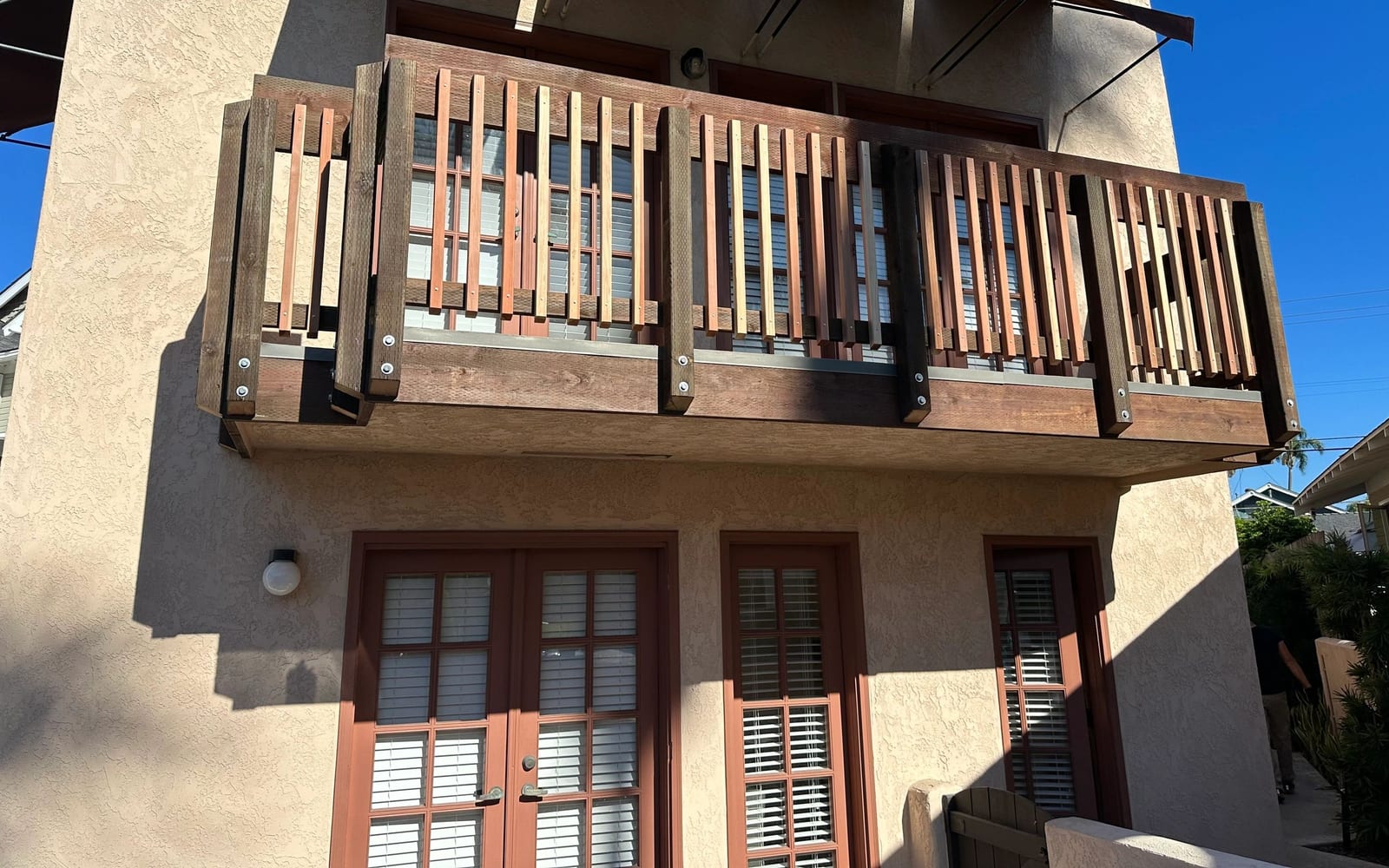
A stair is several connected repair zones
An exterior stair includes more than treads. Landings, stringers or other supports, posts, railings, edge details, wall connections, coatings, concrete transitions and the route below can all influence a repair. Water may enter at one location and appear at another. Movement at a railing can originate in the attachment substrate rather than the visible rail. A responsible first review maps the symptom to the surrounding assembly without assuming a cause that has not been verified.
Separate the observed fact from the repair assumption
Useful observations are concrete: a tread moves when used, a coating is peeling, rust is visible, a crack has changed, or staining appears after rain. Statements such as “the framing is rotten” or “the railing is not compliant” require more support. AWC records what can be seen, what the customer or report states, what remains concealed and what investigation may be needed. That separation prevents a preliminary conversation from becoming a false diagnosis.
Open only with a defined purpose
Selective opening may be appropriate when the repair depends on concealed material, connection or moisture conditions. The written plan should say where opening is expected, how occupants and adjacent finishes are protected, what documentation is taken and how discoveries are handled. Opening everything without a decision path creates cost and disruption. Refusing to look when concealed condition controls the repair creates a different risk. The evaluation should define the smallest useful next step.
Coordinate the visible finish with the underlying work
A strong repair scope carries the work through framing or substrate repair, water-management details, railing coordination and agreed finish restoration. It identifies where color, texture, material or coating matching may be limited and whether refinishing stops at the repair area or a larger visual break. This matters at occupied rentals and managed properties where owners need predictable limits and residents need a clear path back to normal use.
Use a paid evaluation for uncertain multi-trade work
Exterior stairs often combine diagnostic, structural, waterproofing, concrete, metal, stucco and access questions. For detailed work, AWC may recommend the $250 Site Evaluation + Written Bid Package. The fee is credited back if the construction project is approved within 30 days. The evaluation is used to gather site information and prepare a written bid; it does not replace engineering, statutory inspection or agency direction when those are required for the property.
Start with wide and close photos, the affected route, property type, available reports and access conditions. Restrict use and follow responsible property-specific direction if the assembly appears unsafe.
Continue planning
Wood Exterior Stairs: Planning Around Decay and Hidden Damage
A practical guide to soft wood, peeling finishes, stains and concealed-condition planning at exterior stairs and landings.
Read the guideExterior Stair Landing Leaks and Waterproofing Interfaces
Plan exterior stair landing leak repairs by reviewing surfaces, edges, walls, penetrations, drainage and concealed substrate risk together.
Read the guideExterior Stair Railing and Guard Repair Planning
Plan loose, corroded or damaged exterior stair railing repairs around attachments, substrates, finishes and occupied-property access.
Read the guide